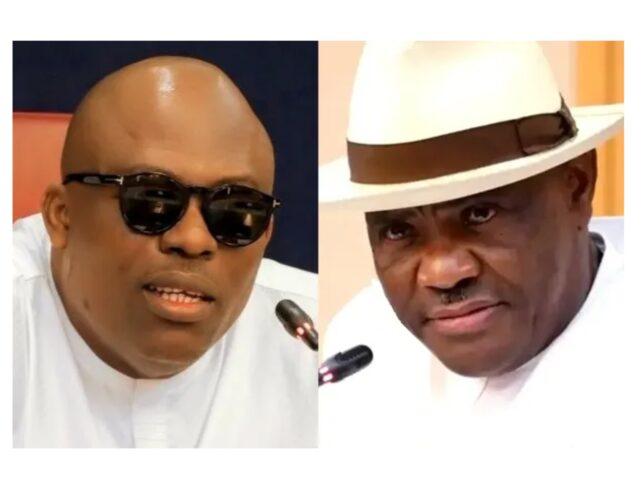
The recent outburst by the Minister of the Federal Capital Territory (FCT), Nyesom Wike, should deeply concern every Nigerian who holds democratic values dear. Wike, speaking publicly, declared that Governor Siminalayi Fubara of Rivers State was “gone.” He even boasted that he had sought his removal and thanked President Bola Ahmed Tinubu for “saving the situation” by suspending the governor and declaring an emergency rule.
These are not just reckless statements—they are a direct affront to democracy, a slap in the face of every Rivers voter, and an insult to the spirit of constitutional governance. Wike is attempting to play god in a state he no longer governs. That must not be allowed to stand.
Let’s get the facts straight: Siminalayi Fubara was elected—not appointed. He did not assume office as a mere placeholder or political proxy. He earned his position through the ballot box, gaining the trust and mandate of the people of Rivers State. Therefore, any rhetorical or political attempt to delegitimize his tenure is an attack on the people’s will.
Wike’s claim that he “wanted Fubara gone,” and that the president did the people a favor by suspending him, reeks of authoritarianism. In any healthy democracy, such remarks would prompt investigations, not praise. If a sitting minister can admit, on record, to orchestrating the removal of a state governor, then Nigeria is dangerously close to becoming a banana republic.
It’s important to recall that Wike himself is a product of the democratic process. He served as governor for two full terms, benefiting from the very system he now seeks to undermine. The people of Rivers respected his office during his tenure—despite numerous accusations of highhandedness. Now, having vacated that office, he cannot demand to rule the state from behind the curtain, as though governance is a birthright.
Democracy is not a relay race where one hands over the baton only to chase down the next runner and trip them mid-race. Once your time is up, you step aside. Whether your successor follows your path or not is their prerogative. Wike had his time. Now, it is Fubara’s.
Yet, as soon as Fubara began to assert his independence, Wike and his loyalists launched a calculated campaign to sabotage him—from legislative maneuvers and threats of impeachment to local government disruptions. It is a clear attempt to turn Rivers State into a personal fiefdom, ruled from Abuja.
To compound matters, Wike has now praised President Tinubu for imposing an unconstitutional state of emergency in March 2025—a move that saw the suspension of not just the governor, but his deputy and the entire state assembly. This defies the 1999 Constitution, which clearly outlines the process for declaring a state of emergency: such a move must be approved by the National Assembly and can only follow genuine breakdowns in law and order—not political disagreements.
Wike’s celebratory tone—claiming Rivers people should be “grateful” and should “wash the president’s feet”—speaks volumes about the political elite’s mindset. To them, power is not a mandate from the people, but a gift granted by political overlords.
But the people of Rivers must push back. They must reaffirm that their votes matter, and that only the courts—not disgruntled godfathers—can determine the legitimacy of an elected official. Fubara remains the constitutionally recognized governor of Rivers State, and no amount of political maneuvering can change that.
To reduce an elected office to a favor granted—and withdrawn—by higher political forces is to trample on Nigeria’s democratic foundations. It is to say that governance is reserved only for the obedient, the pliant, and the controlled.
What Wike is doing amounts to dangerous political overreach. Though now a federal minister, he continues to act like Rivers State is under his command. And alarmingly, he is being enabled by those around him in Abuja.
If democracy is to survive, Nigeria must rid itself of this toxic godfather culture. Elected officials must be allowed to serve independently, free from the stranglehold of their predecessors. A governor answers to the people—not to the man who preceded him.
If Rivers falls to political bullying, other states will follow. Today it’s Rivers; tomorrow it could be Enugu, Benue, or Zamfara. This culture of interference is a virus that must be contained before it metastasizes.
The people of Rivers deserve peace and autonomy. They deserve institutions that work for them—not puppets of Abuja or pawns of retired emperors.
To Wike, this must be clear: you are no longer the governor. You may not approve of Fubara’s methods, but you must respect the office he holds. Democracy does not revolve around your approval.
Stop undermining the will of the people. Stop treating Rivers State as personal property. Fubara, like any elected leader, is not perfect—but he is elected. And that, more than anything, is what matters.