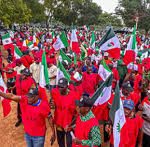
Abuja – The Nigeria Labour Congress (NLC) and Trade Union Congress (TUC) have criticised the Federal Government for what they describe as persistent mismanagement and neglect of the nation’s energy sector, attributing its failure to poor leadership and lack of stakeholder engagement.
In a joint address delivered during the 2025 May Day celebration, NLC President Joe Ajaero and TUC President Festus Osifo said Nigeria’s energy crisis is a result of systemic leadership failure, policy inconsistency, and corporate exploitation.
“If government truly wishes to deliver an effective energy sector to Nigerians, it must sit down with critical stakeholders to turn the sector around,” the labour leaders said.
They lamented the irony of Nigeria’s natural resource wealth being poorly managed, resulting in a country rich in crude oil but dependent on imported petroleum products.
“We have crude, yet Dangote claims to import crude to run his refinery. Dangote exports refined products, yet we import refined petroleum products. This defies logic,” the statement read.
The unions also criticised the state of electricity generation in Nigeria, calling it “disquieting” that a country of over 200 million people generates just over 5,500 megawatts (MW) — of which only about 4,000MW reaches homes and industries — while South Africa, with a far smaller population, generates over 43,000MW.
“This is a glaring example of mismanagement, corporate exploitation, and governmental negligence,” the statement continued. “Energy poverty continues to strangle Nigeria’s economic growth and stifle industrial development.”
They also questioned the practicality of the recently announced ₦10 billion solar investment for the Presidential Villa in the face of nationwide hardship caused by high electricity tariffs.
“If the President is sinking ₦10 billion into solar to reduce electricity costs in the Villa and state officials are lamenting high bills, what then is the fate of the average Nigerian?”
Labour described the power sector privatization as “a daylight heist and monumental failure,” saying it has done little to improve electricity access or affordability.
“Nigerians are paying exorbitant tariffs for darkness, while estimated billing continues as legalized robbery. If we are serious about development, we must be intentional about fixing the power sector.”
They urged the federal government to urgently engage with labour and civil society groups to rescue the energy sector from collapse and return it to public service, rather than profit-driven exploitation.