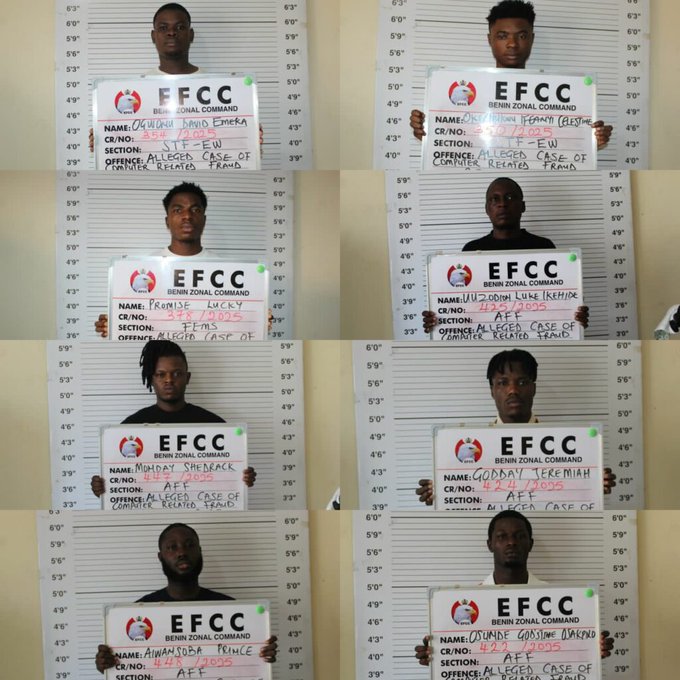
Benin City, Edo State – The Economic and Financial Crimes Commission (EFCC) has secured the conviction of 23 internet fraudsters before the Edo State High Court sitting in Benin City. The convictions were handed down between April 11 and 17, 2025, by Justices W.I. Aziegbemhin and A.N. Erhabor.
This was disclosed in an official statement posted on the EFCC’s verified X (formerly Twitter) account on Saturday.
The convicted individuals include: Uzorchukwu Peace Udoka, Erubasa Oghenetega, David Ogwunu, Jude Okolie, Lucky Ehizojie, Chineye Isioma Christian, Obadiunor Joseph Ikechukwu, Ugochukwu Adingwu, Ifeanyi Okechukwu, Patrick Chinedu Chukwujekwe, Ugboh Chibuzor, Monday Shedrack, Udochukwu Onuka, Uzodion Luke, and Ehighola Emmanuel Akhere.
Others are: Godstime Osunde Oskpolor, Promise Onyugboh, Onuka Patrick, Chinonso Peter Iwuchukwu, Ajayi Aisosa, Aiwansoba Prince, Goddey Jeremiah, and Ojimah John Oseni.
According to the EFCC, the convicts were arraigned on separate one-count charges bordering on obtaining by false pretence, retention of proceeds of crime, and possession of fraudulent documents.
A sample charge read in court stated: “That you, Chinonso Peter Iwuchukwu, on or about the 12th of April, 2025, within the jurisdiction of this Honourable Court, did have in your possession documents which you knew or ought to have known contained false pretence…”
All 23 defendants pleaded guilty to the charges. The prosecution counsel—F.A. Jirbo, I.M. Elodi, and K.Y. Bello—urged the court to convict them accordingly, while defence counsel appealed for leniency, citing remorse and willingness to reform.
Justice A.N. Erhabor sentenced 16 of the convicts to two years’ imprisonment with an option of a ₦200,000 fine. Two others received three years’ imprisonment or a ₦200,000 fine. Justice Aziegbemhin handed down similar sentences to five other convicts, while two individuals received stricter penalties—three years’ imprisonment with an option of a ₦500,000 fine.
All convicts forfeited mobile devices, laptops, and funds traced to their accounts to the Federal Government, as proceeds of crime. They also signed undertakings to exhibit good conduct henceforth.
The EFCC noted that the convictions followed a sting operation by its Benin Zonal Directorate, based on credible intelligence linking the individuals to online fraud.